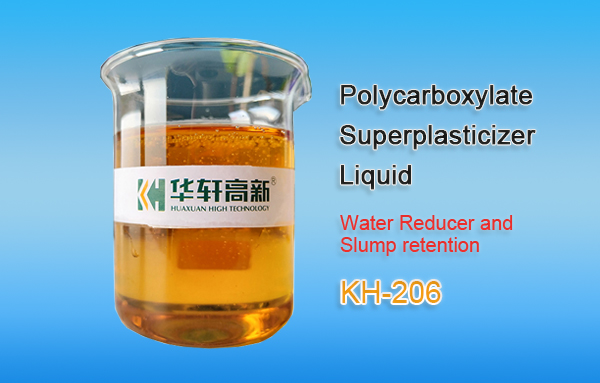
KH-206, as a product developed by Huaxuan, is a new generation of polycarboxylate superplasticizer, which can meet various concrete performance requirements. It has a high water reduction rate and excellent slump retention.
Complies with The ASTM C 494 Norm
ASTM C 494, Type G
Advantages:
·High Water Reduction Rate: High water reduction, low dosage, reducing water usage, and enhancing the strength of the concrete.
·High Plasticity Retention: It has excellent adaptability to various types of cement and other cementitious materials and has excellent slump retention.
·High Adsorption: It has good adsorption for sand and gravel containing powder and mud, which can enhance the cohesion of concrete.
·High Durability: It strengthens the compactness of hardened paste, improves shrinkage and creep properties, reduces cracks, and enhances durability.
·Eco Friendly: Does not contain harmful substances, safe and environmentally friendly.
Technical Data:
| KH-206 Main Specifications | ||||
| NO | Test Item | Criterion | Detection result | |
| 1 | Appearance and color | Colorless transparent or light yellow liquid | Colorless transparent or light yellow liquid | |
| 2 | Water reduction rate /% | ≥25 | 30 | |
| 3 | Solid content (%) | 30~50±1.0 | 40~50±1.0 | |
| 4 | Slurry fluidity (mm) | ≥220 | 230 | |
| 5 | Compressive strength ratio (%) | 1d | ≥170 | 178 |
| 3d | ≥160 | 163 | ||
| 7d | ≥150 | 155 | ||
| 28d | ≥140 | 142 | ||
| 6 | Gas content /% | ≤6.0 | 2.0 | |
| 7 | pH value (20℃) | 6~8 | 7.0 | |
| 8 | Density/(g/cm3) | 1.06~1.14 | 1.10 | |
| 9 | Reinforcement corrosion | The presence of corrosion hazards should be indicated | No | |
| 10 | validity | / | 6 months | |
| 11 | package | / | IBC ton barrel, 1000kg/ barrel | |
| 12 | store | / | Store in a dry and ventilated place, away from direct sunlight | |
Product application:
KH-206 is suitable for various portland cement concrete systems. Such as in:
·Civil buildings
·Roads
·Bridges
·Airports
·Precast concrete/ special concrete, etc.
Uses:
KH-206 can be measured and added to the concrete along with the mixing water directly; it can also be diluted to a lower solid content, and then added to the concrete in corresponding amounts.
The recommended dosage is 0.4-1.0% of the cementitious material. The exact dosage should be determined after trial mixing, based on concrete design requirements and actual raw material conditions.
Address:Huaxuan Industry Zone, Wuhan Economic and Technological Development Zone, Hubei, China
E-mail:info@whhuaxuan.com
TEl:+86-13285436976
Concern us


